Ice, Silence, and Sweat: The Ancient Rites That Are Reshaping the Modern Athlete
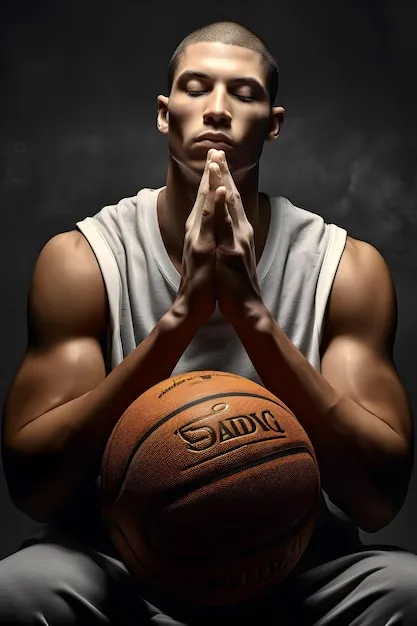
Photo: professional athlete meditating in empty basketball arena before practice, via img.freepik.com
The cryotherapy chamber at an NFL franchise's training facility bears little aesthetic resemblance to the frozen rivers in which Wim Hof disciples immerse themselves each winter morning. And yet the principle animating both practices is, at its core, identical: the deliberate imposition of discomfort upon the body, with the understanding that something valuable — something that cannot be acquired through comfort — waits on the other side.
This is the logic of asceticism. It is among the oldest ideas in the human religious imagination, present in the desert fathers of early Christianity, in the fasting traditions of Islam and Judaism, in the rigorous physical disciplines of Buddhist monasticism. And it is, increasingly, the logic that structures the preparation routines of some of the most celebrated athletes in American professional sports.
The Monastery and the Locker Room
Steph Curry arrives at Chase Center hours before his teammates. The specific contents of his preparation routine have been documented extensively — a layered sequence of shooting drills, movement exercises, and what observers have described as a meditative quality of focus that distinguishes his warm-up from mere physical repetition. Whether Curry frames this in explicitly spiritual terms is less significant than what the practice itself reveals: a commitment to ritual that extends far beyond the requirements of physical maintenance.
Ritual, as distinct from routine, implies meaning. A routine is a sequence of actions performed for functional reasons. A ritual is a sequence of actions performed with the understanding that the manner of performance — the attention, the intention, the consistency — is itself part of what is being cultivated. The distinction matters enormously when examining what contemporary athletes are actually doing when they meditate before games, fast during the offseason, or submerge themselves in ice water at five in the morning.
Russell Wilson, during his tenure with the Seattle Seahawks, became one of the most visible proponents of what might be called contemplative preparation. His practice of meditation and visualization was not incidental to his performance philosophy — it was central to it. Wilson spoke repeatedly about the relationship between mental stillness and physical execution, a connection that Zen Buddhist teachers would recognize immediately and that sports psychology has spent decades attempting to quantify.
What the Body Knows That the Mind Resists
The ice bath — or, in its more technologically elaborated form, the whole-body cryotherapy session — has become almost ubiquitous in professional locker rooms across the NBA and NFL. Its physiological benefits are real and well-documented: reduced inflammation, accelerated recovery, modulation of the autonomic nervous system. Sports medicine can account for these effects in precise biochemical terms.
But something else appears to be happening in these chambers, something that the recovery metrics do not fully capture. Athletes who practice cold immersion with any regularity describe an experience that consistently exceeds its physical benefits. The confrontation with extreme cold, the necessity of breath control, the deliberate cultivation of equanimity in the face of an acutely uncomfortable stimulus — these are not merely recovery techniques. They are, in a meaningful sense, meditations on the relationship between will and circumstance.
This is ancient territory. The Stoic philosophers of Rome and Greece prescribed voluntary discomfort — cold baths, modest meals, the deliberate forgoing of luxury — not as athletic preparation but as philosophical practice. The goal was the development of what they called apatheia: not apathy in the modern sense, but a trained independence from circumstance, a capacity to remain centered when conditions are adverse. The application to athletic competition is almost too obvious to require elaboration.
Fasting and the Hunger for Something More
Intermittent fasting and more extended fasting protocols have found an unlikely home in professional sports nutrition, a field that spent decades operating on the assumption that more calories, more frequently, was always superior. The reversal has been significant enough to attract attention beyond the sports medicine community.
Several NBA players, including Kyrie Irving during various periods of his career, have spoken about dietary restriction practices that draw explicitly from spiritual traditions — in Irving's case, from his engagement with indigenous and holistic philosophies that frame food not merely as fuel but as a relationship between the body and the natural world. Whether one finds Irving's specific philosophical framework persuasive, the underlying impulse deserves serious consideration.
Fasting, across virtually every major religious tradition, serves a dual function. It is simultaneously a practice of physical discipline and a method of cultivating attention. The hunger that fasting produces is not merely an inconvenience to be managed — it is, in the traditional understanding, a teacher. It reveals the degree to which ordinary consciousness is governed by appetite, and it creates a space in which a different quality of awareness becomes accessible.
For the athlete, this quality of awareness has direct competitive relevance. The ability to perform under conditions of physical discomfort, to maintain decision-making clarity when the body is demanding relief, to remain present in the late stages of a close game when fatigue is distorting perception — these capacities are precisely what fasting, practiced consistently, is understood to develop.
Genuine Seeking or Performance Theater?
The question of authenticity shadows this entire conversation. Professional athletes operate within an ecosystem in which personal branding is as consequential as on-court performance, and the aesthetic of mindful, spiritually attuned athleticism is commercially attractive in ways that create obvious incentives for performance rather than practice.
This is a legitimate concern, and it warrants honest acknowledgment. The meditation app partnership, the wellness brand ambassador role, the carefully curated social media post from the pre-dawn training session — these are real phenomena, and they exist in complex relationship with whatever genuine practice may underlie them.
And yet the dismissal of these practices as purely performative fails to account for what is actually observable in the careers of athletes who have committed to them seriously. The consistency of the results — the extended careers, the late-career peaks, the demonstrated capacity for sustained excellence under pressure — suggests that something real is being developed through these rituals, regardless of how they are subsequently packaged for public consumption.
The Body as Sacred Site
What connects the meditation session, the ice bath, the fasting protocol, and the pre-dawn shooting routine is a common underlying conviction: that the body is not merely an instrument to be optimized but a site of genuine meaning — a place where the work of becoming, in the fullest sense, actually occurs.
This is, at its foundation, a spiritual claim. It is the claim that the ancient traditions of physical discipline were making when they developed their practices, and it is the claim that the most thoughtful contemporary athletes are, in their own idiom, recovering.
The temple, it turns out, was always the body. The most serious practitioners have simply remembered where to show up.