Before the Shrine of the Jersey: A Meditation on What We Actually Worship on Game Day
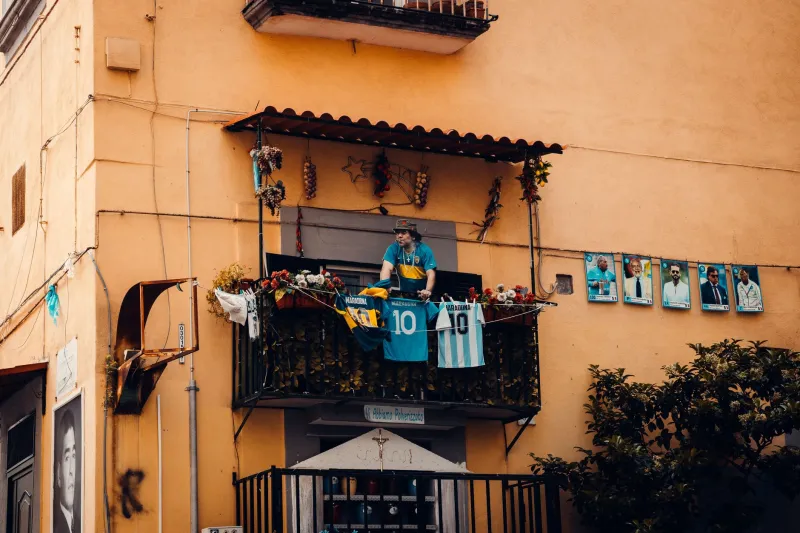
There is a moment familiar to millions of American households: the basement wall arranged with the precision of a museum curator. Framed jerseys, autographed photographs, a commemorative football resting on a stand as though it were a relic in a cathedral's apse. The fan who built this shrine would likely laugh at the comparison. And yet the architecture of the room tells a different story than the mouth of its architect.
The Vocabulary of Devotion
We have borrowed the language of faith so thoroughly that we barely notice it anymore. Teams have "congregations" of fans. Stadiums are called "hallowed grounds." Athletes are "worshipped," and their greatest performances are "transcendent." When a beloved player leaves in free agency, we speak of betrayal in terms once reserved for broken covenants.
The Hebrew prophets understood this linguistic drift long before it arrived on American sports talk radio. Their concern was never merely about carved statues; it was about the misdirection of the heart. The warning against the golden calf was not a critique of art but of substitution — the human tendency to place something visible, controllable, and thrilling in the seat reserved for something larger.
By that measure, the question worth asking is not whether sports fandom resembles religion. It plainly does. The question is whether it has begun to replace the things it resembles.
The Cost of the False Altar
Consider what American fandom asks of us. Season tickets that rival a car payment. Apparel lines that turn infants into walking billboards. Sunday schedules rearranged around kickoff like the old blue laws once rearranged them around church. Public treasuries — our treasuries — pour billions into stadiums while the communities surrounding them often struggle to fund schools and libraries.
None of this is inherently wicked. Devotion to a shared banner has knit strangers into genuine neighbors, particularly in cities where little else binds people across lines of class and neighborhood. The tavern in Green Bay and the barbershop on Chicago's South Side are, in their way, houses of assembly as real as any sanctuary.
But idolatry, the prophets insisted, is diagnosed by its fruits. What does the devotion produce? When a season's failure produces rage rather than grief; when a fan's identity collapses entirely into a team's win-loss record; when a community will fund an arena but not its own children — the calf has taken the field.
The Liturgy Worth Keeping
Here is the uncomfortable part for those of us who write about the sacred dimensions of sport: the ritual itself is not the problem. Ritual is ancient and good. The shared calendar, the communal song, the standing together in weather — these are disciplines that train the heart toward something beyond the self.
The Hebrew Bible's deeper teaching is not that devotion is dangerous, but that devotion demands an object worthy of it. A team is worthy of our attention. A team is not worthy of our souls. The distinction matters most in defeat, which is the true test of any fan's theology. The idolater is destroyed by the loss; the healthy devotee is merely saddened, then restored by the other loves in his life.
Perhaps that is the examination fans ought to perform each autumn, as the season opens like a new liturgical year. Ask not how much you love the team, but what the love has displaced. If the shrine in the basement coexists with a full table, a generous neighborhood, and a self that survives a losing season, then the jersey is just a jersey.
If not, the prophets have a word for us — and it is not a word about sports at all.