Forty Days in the Wilderness: How Elite Athletes Transformed the Offseason Into a Contemplative Practice
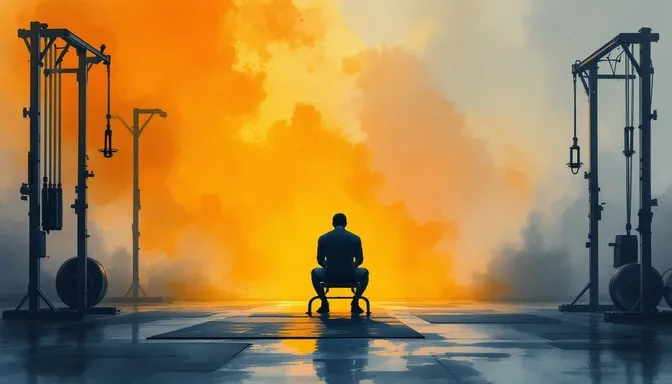
Photo: athlete alone meditating in empty gym at dawn peaceful solitude, via images.stockcake.com
Long before sports scientists quantified recovery metrics and performance coaches designed isolation protocols, monks understood that periodic withdrawal from the world was not weakness but wisdom. Today's elite athletes, whether they invoke that tradition explicitly or not, have arrived at strikingly similar conclusions—and the parallels between ancient contemplative life and the modern athletic offseason are more than metaphorical.
The monastery was never simply a place of refuge. It was a technology—a carefully engineered environment designed to strip away distraction and allow the practitioner to encounter, with maximum clarity, the discipline they had consecrated their life to. The Rule of Saint Benedict, written in the sixth century, prescribed the monk's day in meticulous detail: hours of prayer, hours of labor, hours of silence, hours of study. Nothing was left to improvisation. The structure was the point. Without it, the contemplative life collapsed into mere idleness.
Read those principles against the offseason regimens of contemporary professional athletes, and the resemblance is difficult to dismiss as coincidence.
The Architecture of Withdrawal
When LeBron James retreats to his private training facility in the weeks following a season, when a veteran NFL quarterback disappears to a mountain property in Montana to work on mechanics and mental clarity, when an NBA guard undergoes a self-imposed media blackout while rebuilding his body—these are not merely logistical decisions. They are, structurally, acts of monastic withdrawal.
The deliberate removal of oneself from the noise of public life, from the obligations of celebrity, from the constant stimulation of the modern media environment, mirrors the desert fathers' retreat from Alexandria into the Egyptian wilderness in the third and fourth centuries. Those early Christian ascetics did not flee the city because the city was evil. They fled because the city made genuine attention impossible. The athlete who powers down social media and decamps to a private facility is making the same calculation: that depth of practice requires depth of quiet.
Sports psychologists have begun to formalize what contemplative traditions knew intuitively. Research on deliberate practice consistently identifies focused, distraction-free repetition as the irreducible condition of elite skill development. The monastery's silence was not incidental to the monk's formation—it was constitutive of it. The same is true of the serious athlete's offseason retreat.
The Hours and the Regimen
One of the most striking structural parallels between monastic life and elite athletic preparation is the governing role of the daily schedule. The monk's day was divided into canonical hours—fixed points of prayer that organized all other activity. The discipline was not in the content of any single hour but in the unwavering fidelity to the rhythm as a whole.
The offseason programs of elite athletes display an almost identical logic. The alarm at 5:30 a.m. The cold immersion at 6:00. The movement work before breakfast. The film or film equivalent—the careful review of one's own performance—in the afternoon. The structured rest. The evening reflection or meditation. What appears from the outside as mere athletic training is, from the inside, something closer to a rule of life.
Stephen Curry has spoken publicly about his incorporation of meditation into his daily preparation. Tom Brady's TB12 Method—whatever one thinks of its nutritional claims—is essentially a monastic rule applied to athletic performance: a comprehensive, all-encompassing framework that governs sleep, diet, movement, and mental state. Kobe Bryant's famed 4:00 a.m. workouts were not simply a training strategy. They were an expression of what Bernard of Clairvaux might have called fervorem spiritus—the ardor of the spirit that refuses to be satisfied by ordinary effort.
Solitude as Preparation, Not Punishment
American culture has a complicated relationship with solitude. It tends to read withdrawal as either punishment or pathology—a sign of something wrong rather than something right. The athlete who goes quiet during the offseason is often described in the press as "mysterious" or "reclusive," as though the desire for undistracted preparation were a form of antisocial behavior.
The contemplative traditions offer a corrective vocabulary. In those frameworks, solitude is not the absence of community but its prerequisite. The monk who has not cultivated an interior life has nothing genuine to offer the community when he returns to it. The athlete who has not done the quiet, unglamorous work of the offseason—the repetition, the reflection, the honest confrontation with weakness—has nothing new to bring to the team when the season resumes.
This is why the most admired veteran athletes tend to speak about the offseason not as a vacation but as a vocation—a calling that demands as much of them as the season itself, only differently. The effort is less visible, the stakes less immediate, the rewards deferred. These are precisely the conditions under which genuine formation occurs.
The Dark Night of the Offseason
Not every athlete emerges from the offseason renewed. Some return diminished—not physically, but spiritually. They have spent the months avoiding the honest reckoning that genuine contemplative practice demands. They have trained the body while neglecting the deeper questions: Why do I play? What does this cost me? What am I becoming through this discipline?
Saint John of the Cross described the noche oscura—the dark night of the soul—as the necessary passage through which the contemplative must travel before arriving at genuine transformation. Athletes who have suffered significant injury, public failure, or personal crisis during the offseason and emerged the following season with something unmistakably different in their game—a quieter confidence, a more economical style, a deeper composure under pressure—have, in a real sense, passed through their own dark night.
The offseason, at its most demanding, is not a rest. It is a crucible. And the athletes who enter it with the seriousness it deserves—who treat the silence and the solitude and the repetition as spiritual as well as physical labor—are the ones most likely to emerge from it genuinely transformed.
What the Rest of Us Might Learn
Holy Ballism has always maintained that the athlete's life, at its most disciplined, is not merely an object of entertainment but a text worth reading carefully. The offseason, in particular, offers instruction that extends well beyond the locker room.
The monastic insight that structured withdrawal produces genuine renewal is not a relic of medieval religious life. It is a durable truth about human beings and the conditions under which they grow. The athlete who disappears into the wilderness for forty days and returns with a new serve, a rebuilt release point, or a recalibrated mind is not simply a better player. He or she is a demonstration of what intentional solitude can accomplish.
In a culture that treats busyness as virtue and visibility as validation, the offseason monk—the athlete who goes quiet and goes deep—offers a quiet rebuke and a quiet invitation. The invitation is this: that the most important work often happens in the places where no one is watching, in the hours before dawn, in the silence that most people spend their lives avoiding.
The monastery has always known this. Now, slowly, the locker room is learning it too.